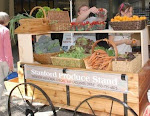
In observance of Independence day the produce stand will not be open this Friday, July 3rd.
We will be back next week Friday, July 10 from 11am-3pm at our normal spot in front of Tresidder Student Union next to Jamba Juice.

Combine the basil in with the pine nuts, pulse a few times in a food processor or blender. Add the garlic, pulse a few times more.
Slowly add the olive oil in a constant stream while the food processor or blender is on. Stop to scrape down the sides with a rubber spatula. Add the grated cheese and pulse again until blended. Add a pinch of salt and freshly ground black pepper to taste.

Basil now grows in many regions throughout the world, but it was first native to India, Asia and Africa. It is prominently featured in varied cuisines including Italian, Thai, Vietnamese and Laotian while most famous as a key ingredient in pesto. The name "basil" is derived from the old Greek word basilikohn, which means "royal," reflecting that ancient culture's attitudes towards an herb that they held to be very noble and sacred.
Basil is an excellent source of vitamin K and a very good source of iron, calcium and vitamin A. In addition, basil is a good source of dietary fiber, manganese, magnesium, vitamin C and potassium. In addition basil's eugenol content, which can inhibit the activity of an enzyme in the body called cyclooxygenase, qualifies it as an "anti-inflammatory" food that can provide important healing benefits along with symptomatic relief for individuals with inflammatory health problems like rheumatoid arthritis or inflammatory bowel conditions.
Fresh basil should be stored in the refrigerator wrapped in a slightly damp paper towel. It may also be frozen, either whole or chopped, in airtight containers. Alternatively, you can freeze the basil in ice cube trays covered with either water or stock that can be added when preparing soups or stews.
(for more information visit http://www.whfoods.com)

Parsely derives its name from the Greek word meaning "rock celery." Its delicious and vibrant taste and wonderful healing properties are often ignored in its popular role as a table garnish. Parsley is native to the Mediterranean region of Southern Europe.
While it has been cultivated for more than 2,000 years, parsley was used medicinally prior to being consumed as a food. The ancient Greeks held parsley to be sacred, using it to not only adorn victors of athletic contests, but also for decorating the tombs of the deceased. The practice of using parsley as a garnish actually has a long history that can be traced back to the civilization of the ancient Romans.
Parsley is an excellent source of vitamin A, vitamin C, and vitamin K and a good source of iron and folate. The flavonoids in parsley-especially luteolin-have been shown to function as antioxidants that combine with highly reactive oxygen-containing molecules and help prevent oxygen-based damage to cells. Parsley's volatile oils-particularly myristicin-have been shown to inhibit tumor formation in animal studies, and particularly, tumor formation in the lungs.
Fresh parsley should be kept in the refrigerator in a plastic bag. If the parsley is slightly wilted, either sprinkle it lightly with some water or wash it without completely drying it before storing in the refrigerator.
(for more information visit http://www.whfoods.com)